
Transport and fleet
Event transport planning: why return and availability are different
A truck can be back at the warehouse and still be unavailable for the next job. Plan the full commitment through unloading and handover.
Reserve the vehicle for the complete task
Transport does not start at the venue or automatically end on return. The commitment includes preparation, departure, travel, handover, return, unloading and any planned inspection or reload buffer.
When two jobs need the same vehicle, compare the complete transport windows rather than the event times alone.
Set return and availability separately
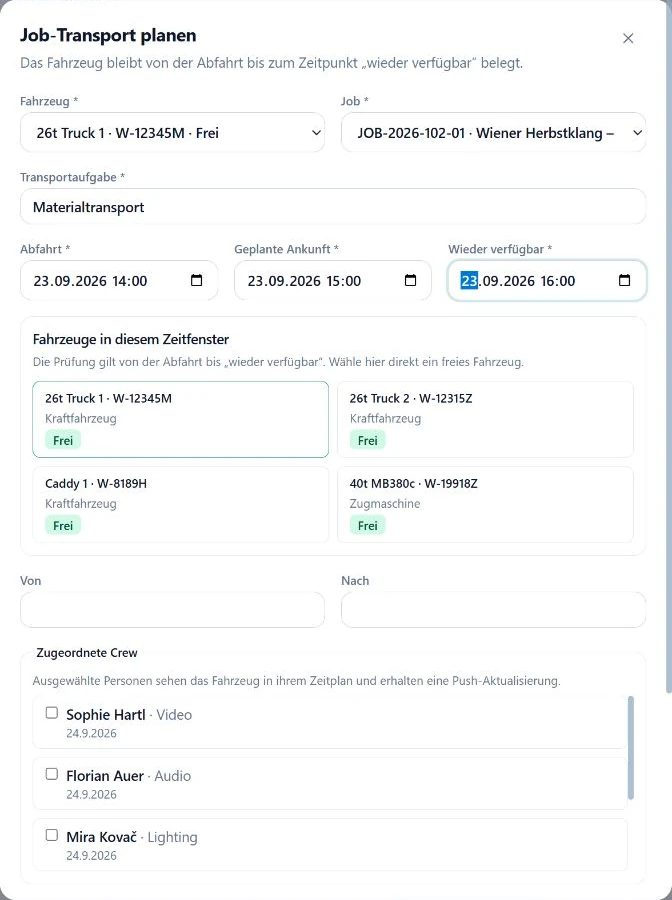
In the example, the truck returns at 01:00. Unloading and inspection continue until 03:00, so the next load-in can use it only after 03:00. Those two hours represent planned work rather than a hidden safety value.
| Time | Planning step |
|---|---|
| 18:00 | Depart for Job A |
| 19:00 | Arrival and handover |
| 01:00 | Return to warehouse |
| 01:00 to 03:00 | Unload, inspect and prepare |
| 03:00 | Available for Job B |
Record the window in the job transport
The SAVIE transport dialog connects vehicle and job with departure, planned arrival, return and the available-again time. It keeps the reason for the post-return block visible.
These fields are not route optimisation or automatic driving-time compliance calculations. The responsible scheduler supplies realistic travel and loading intervals.
Check the second job against the whole window
If Job B starts at 02:00, it overlaps the 03:00 availability even though Job A has ended. SAVIE blocks overlapping reservations for the same vehicle. Do not shorten the first interval to evade the check; use another vehicle or change the operation realistically.
For a paired vehicle, check the trailer or semi-trailer across the same interval.
Align drivers and passengers with transport time
Availability for the show does not prove that the same person can make the early departure. Compare the driver, passengers and confirmed shifts with the transport window. A licence skill is planning evidence; suitability for the exact vehicle still needs review.
When time changes, update the vehicle commitment, crew schedule and briefing together.
Worksheet for every transport chain
Write the steps in this order before entering the commitment in the plan.
- Job and destination are clear.
- Loading and departure planned.
- Arrival and handover agreed.
- Return is realistic.
- Unloading, inspection and buffer included before availability.
- Driver, passengers and paired trailer checked.